Fresh air requirements vary with climate, building use, and available duct space. A Fresh Air Fan that suits a compact apartment may not serve a busy workshop or a large commercial building. Buyers need more than a high airflow figure. Noise, pressure, power use, filter access, and installation conditions matter too.
This guide compares common options, including axial fans, centrifugal fans, inline duct fans, and energy-recovery ventilation units. Each has practical strengths. Axial models can move air along a short, direct path, while centrifugal designs often handle higher resistance from bends, filters, or longer ducts. Inline fans fit inside duct runs, where space and service access still need careful planning. Energy-recovery units can transfer heat between outgoing and incoming air, but their performance depends on climate, controls, and maintenance.
Small details count. A narrow grille can restrict airflow. A poorly placed intake may draw dust or exhaust from nearby sources. Buyers should compare fan curves and sound data, not just the maximum airflow printed on a product page. Verify voltage, dimensions, materials, and test conditions with the supplier. Where possible, review independent test information and consult a qualified ventilation professional before specifying a system. One point deserves honest attention: published ratings do not always reflect real installation conditions. This overview helps global buyers ask better questions and shortlist suitable fan types, while recognizing that the right choice depends on the building, not the label.
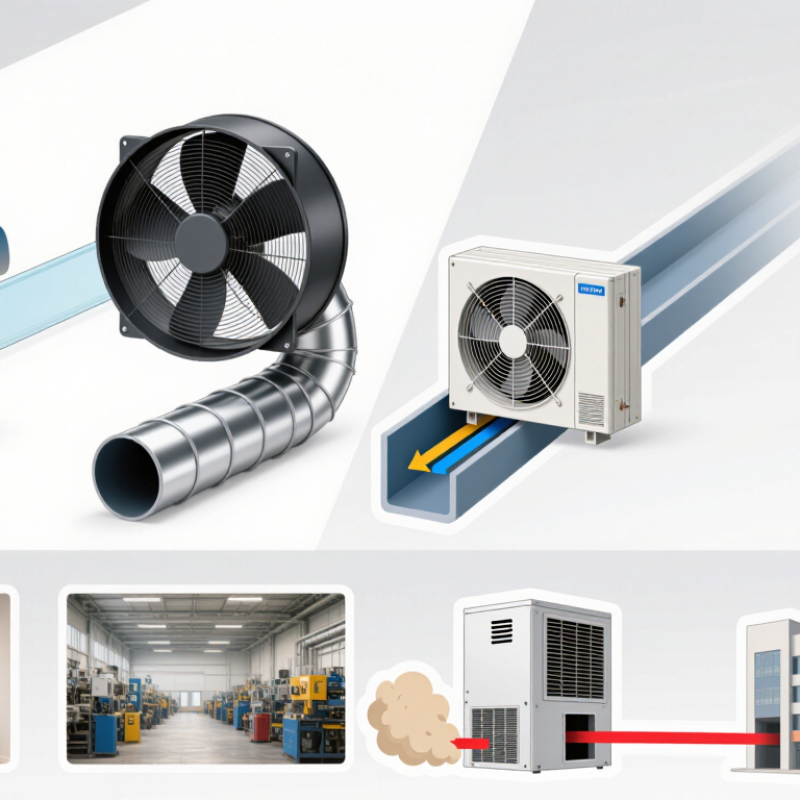
A fresh-air fan brings outdoor air into a building; an exhaust fan removes indoor air. The difference is airflow direction, not simply fan shape. Supply fans may sit near an exterior intake, pulling air through filters before it reaches occupied rooms. Exhaust fans often serve kitchens, washrooms, or utility areas, where they draw odors and moisture toward an outdoor discharge. Direction matters.
These fans also affect building pressure. If exhaust volume exceeds incoming supply, air may enter through gaps around doors or windows. That can bring dust or drafts. If supply is too high, air may escape through unintended openings. A balanced ventilation system coordinates both flows, while a heat-recovery ventilator transfers heat between outgoing and incoming airstreams. It is not just a fan; it is a matched ventilation unit.
ASHRAE Standard 62.1 provides ventilation requirements for many nonresidential buildings, while AMCA 210/ASHRAE 51 describes standardized fan performance testing. These references help buyers compare airflow and pressure ratings rather than relying on a motor’s wattage alone. The IEA’s 2023 Global Status Report for Buildings and Construction estimates that buildings used 30% of global final energy in 2022. That figure covers buildings broadly, not fans specifically, but it explains why fan efficiency and correct sizing matter. On drawings, airflow can look perfectly balanced; real filters load with dust, and commissioning sometimes needs a second look.
Fresh air fans move outdoor air into occupied spaces, but airflow alone does not guarantee comfort. Their job begins at an intake, where a weather hood helps limit rain and debris. A filter captures particles; its resistance rises as dust accumulates. The fan must overcome that resistance and pressure losses in ducts, bends, and grilles. Small details matter.
When outside air is cold, a heating coil can temper it before it reaches rooms. In hot weather, cooling coils may lower temperature and remove some moisture. A humidifier may suit dry conditions, though added moisture requires careful control. Controls can adjust dampers or fan speed using schedules, occupancy signals, or indoor air measurements. Not every sensor tells the whole story.
Air is delivered through ducts or introduced into a central air-handling system for mixing. Supply outlets should spread it without creating drafts near desks or beds. During setup, technicians can measure airflow at terminals and compare results with design targets. They should also check filter fit, coil drainage, and maintenance access. Real buildings are imperfect: doors open, filters load unevenly, and outdoor conditions change. Ongoing checks matter.
| Equipment type | How outdoor air is delivered | Air treatment and energy recovery | Common applications | Key buyer considerations |
|---|---|---|---|---|
| Wall-mounted room ventilator | Moves outdoor air directly through an exterior wall into one room. Some models alternate between supply and extract; paired units may operate in coordinated cycles. | May include a dust filter and, in some designs, a ceramic heat-storage core. Filtration level and recovery performance depend on the unit. | Individual rooms, apartments, small offices, and retrofit projects without ductwork. | Check wall thickness, outdoor noise, filter access, condensate or frost provisions, and whether the selected operating mode provides balanced ventilation. |
| Inline ducted supply fan | A fan in the duct draws outdoor air through an intake and distributes it to one or more rooms. Separate exhaust or pressure-control arrangements may be needed. | The fan itself does not heat, cool, or dehumidify air. Filters, heating coils, cooling coils, or other treatment components can be added to the system. | Homes, small commercial spaces, and ventilation systems where a straightforward ducted air supply is required. | Select for required airflow at the actual duct resistance; also verify fan speed control, sound levels, filter pressure drop, and access for maintenance. |
| Heat recovery ventilator (HRV) | Supply and exhaust fans move outdoor and indoor air through separate air paths, typically serving multiple rooms through ducts. | Transfers sensible heat between exhaust and incoming air without intentionally transferring moisture. It does not replace dedicated heating or cooling when those are needed. | Homes and buildings in climates where recovering heat from exhaust air is useful and indoor humidity transfer is not a priority. | Compare certified recovery performance, balanced airflow, frost-control strategy, filter availability, and duct layout. |
| Energy recovery ventilator (ERV) | Uses supply and exhaust fans to provide balanced ventilation, commonly through a duct network and an energy-transfer core. | Transfers sensible heat and some moisture between exhaust and incoming air. An ERV can reduce ventilation-related loads, but does not independently provide full humidity control. | Homes and commercial spaces where both heat recovery and some moisture transfer are appropriate for the climate and building operation. | Check the core’s rated performance, operating limits, frost protection, drainage requirements, and compatibility with local humidity-control needs. |
| Dedicated outdoor air system (DOAS) | A dedicated air-handling system supplies measured outdoor air, often through separate ductwork, while other systems handle most space heating and cooling loads. | Can include filtration, heating, cooling, dehumidification, and energy recovery. The installed configuration determines which treatments are provided. | Commercial buildings such as offices, schools, hotels, and healthcare facilities that need controlled ventilation across multiple zones. | Confirm outdoor-air design conditions, required ventilation rates, humidity targets, controls, energy recovery, and coordination with the building’s heating and cooling systems. |
| Make-up air unit (MUA) | A supply fan introduces outdoor air to replace air removed by exhaust systems, helping manage building pressure and provide replacement air. | May provide filtration and heating; cooling, dehumidification, and energy recovery depend on the unit design. A basic fan-only arrangement does not condition incoming air. | Commercial kitchens, industrial spaces, and buildings with substantial process or local exhaust. | Size in coordination with exhaust airflow and pressure strategy; verify discharge location, outdoor design conditions, freeze protection, and required air treatment. |
| Selection note: Airflow, pressure, filtration, recovery, and conditioning requirements depend on the building, climate, occupancy, and applicable codes. Verify project-specific performance with the equipment documentation and a qualified ventilation designer. | ||||
For global buyers in 2026, fresh air fan selection depends on duct layout, airflow needs, climate, and operating costs. Axial fans move air efficiently through short, relatively open paths. They can suit wall-mounted ventilation or compact installations with limited duct resistance. Short ducts matter. Centrifugal fans handle higher static pressure, making them a practical option for longer duct runs, bends, and filters.
Mixed-flow fans combine features of axial and centrifugal designs, offering a useful balance of airflow and pressure in many ducted systems. Inline fans fit within ductwork, which can help when floor or wall space is tight. Some fresh air systems also include heat recovery, reducing the temperature gap between incoming and outgoing air. That benefit depends on climate and usage, so it should not be assumed for every building.
Compare airflow at the required pressure, not just the highest free-air rating on a product sheet. Check sound levels, filter access, electrical supply, and replacement-part availability in the destination market. A quiet fan on paper may sound different after installation. Allow for commissioning measurements; real duct resistance often differs from early estimates. It is easy to over-specify capacity, then regret the extra noise and energy use.
For global buyers, fan type should match the duct route and required airflow, not just the room size. Axial fans suit short, direct paths through walls or roofs. Mixed-flow models can handle moderate duct resistance while keeping noise manageable. Centrifugal fans are often better for longer ducts, bends, and filters that raise static pressure. Check the fan curve at the expected operating point; a high free-air rating can look impressive but disappoint after installation. Measure twice.
Compare airflow, static pressure, power use, and sound together. Ask suppliers for test conditions and performance data, including the effect of filters or grilles. A washable pre-filter may protect equipment, but it also adds resistance when dirty. Set a practical maintenance interval. The detail is easy to miss.
Installation affects real performance. Keep intake openings clear of exhaust outlets, loading areas, and likely dust sources. Use flexible connectors or suitable supports to limit vibration, and leave enough access to clean the fan and replace filters. A tight ceiling void can turn routine service into a costly job. It happens.
Before purchase, confirm that the model suits local electrical supply and site requirements. Check applicable ventilation, energy-efficiency, fire-safety, and noise rules with qualified local professionals; requirements vary by project and jurisdiction. Confirm that wiring protection, weather exposure, and duct penetrations are addressed in the installation plan. Paperwork alone does not prove suitability, so match declared ratings to actual operating conditions.
Indicative upper-end airflow capacity by fan type. Actual capacity varies by model and system resistance; use the manufacturer’s fan curve to select a fan for the required airflow and static pressure.
Selection and compliance: Wall axial fans suit simpler, low-resistance routes; mixed-flow and centrifugal fans are better suited to ducted systems with greater resistance. HRV/ERV units transfer heat (and, for ERVs, moisture) between airstreams. Check local ventilation and energy codes, required airflow, noise limits, electrical requirements, fire and smoke provisions, and service access before installation.
Choosing a fresh air fan starts with the building, not the product label. A small apartment may need a compact, quiet axial fan for a short, straight duct. Larger buildings often have longer duct runs and more bends. A centrifugal fan can maintain airflow against that resistance. Check the required airflow against room use, occupancy, and applicable ventilation guidance. Bigger is not always better.
Climate changes the decision. In cold regions, an energy-recovery ventilator can reduce heat loss while bringing in outdoor air. In humid climates, consider condensate drainage, corrosion-resistant components, and controls that respond to indoor moisture. Hot, dusty locations need effective filtration and filters that are easy to replace. Filters add resistance, though. Confirm the fan can deliver its rated airflow with the selected filter installed.
Look beyond airflow figures. Check sound levels, access for cleaning, duct size, and available electrical supply. In a school or office, low noise matters during occupied hours; in a workshop, robust construction may matter more. Ask an installer to measure airflow after setup, because actual duct conditions can differ from drawings. Even a careful selection can miss something. A filter that is awkward to reach may stay unchanged too long, so maintenance access deserves attention before purchase.