Choosing the best Sewage Water Tank for 2026 starts with a practical question: what will it need to handle every day? Household sewage, commercial wastewater, and temporary storage place different demands on a tank. Capacity matters, but so do site conditions, access for maintenance, expected service life, and the material’s resistance to corrosion. A tank that looks suitable on a product sheet may not fit a narrow yard or a high-groundwater site. Details count.
The scale of infrastructure needs makes careful selection more than a purchasing preference. The U.S. Environmental Protection Agency’s 2022 Clean Watersheds Needs Survey estimated $630.1 billion in wastewater and stormwater infrastructure needs over 20 years. That figure covers a broad range of systems, not tanks alone, but it underscores the value of durable, well-matched equipment. Poor sizing can mean frequent pumping or inadequate reserve capacity. Oversizing can also add cost without solving the real site problem.
This guide compares concrete, fiberglass, polyethylene, and steel tank options, focusing on their strengths, limitations, and typical applications. It also considers installation conditions, maintenance, and the questions buyers should ask suppliers. There is no universal winner. A careful comparison helps, though it cannot replace a qualified site assessment or manufacturer specifications. And some trade-offs remain. The right choice depends on wastewater volume, local conditions, and the level of maintenance a facility can reliably provide.
What Is the Best Sewage Water Tank Type for 2026?
How Sewage Water Tanks Store and Manage Wastewater
A sewage water tank is not just a container; it is a controlled holding and settling stage. Incoming wastewater slows inside the tank, allowing heavier solids to sink and lighter grease to rise. The remaining liquid then moves to an approved treatment or disposal stage. The U.S. EPA’s Onsite Wastewater Treatment Systems Manual explains how tank settling and effluent management support onsite treatment. Capacity, material, access for pumping, and expected peak flows all matter. A tank that looks adequate on paper may struggle during a busy weekend.
The UN World Water Development Report 2017 estimated that over 80% of wastewater worldwide was discharged without adequate treatment. That figure makes reliable storage and onward treatment more than a maintenance detail. A well-designed tank needs secure, watertight construction, ventilation, and accessible inspection points. Concrete, polyethylene, and fiberglass each have different structural and installation trade-offs. Local soil, groundwater, vehicle loads, and cleaning access should guide selection. Real sites are messy, and calculations can miss unusual flow peaks.
Tips: Keep a simple record of inspections and pumping. Watch for slow drains, odors, or wet ground near the tank. Never treat these signs as proof of a full tank; a damaged outlet or blocked pipe can look similar. Have a qualified wastewater professional assess the system before choosing a replacement size.
Typical retention-time ranges help show how different wastewater tanks serve different purposes.
Equalization tanks buffer changing flows, septic tanks provide on-site settling and treatment, primary clarifiers settle solids, and anaerobic digesters stabilize sludge. The digester range shown is solids retention time (SRT); the other ranges are hydraulic retention time (HRT), so they are not directly equivalent. These are indicative engineering ranges, not universal specifications. Tank selection depends on flow, treatment goals, site conditions, and local codes.
In 2026, sewage tanks generally fall into several groups: septic tanks, sealed holding tanks, pump tanks, and tanks within small treatment systems. A septic tank separates solids from wastewater before the liquid moves to a drain field or another approved treatment stage. Inside, heavier material settles, while lighter scum forms at the surface. It needs suitable access for inspection and scheduled pumping.
A holding tank stores wastewater without treating or discharging it. It can suit sites where soil conditions or layout limit other systems, but its fill level must be monitored and collection arranged before it gets too high.
Pump tanks, by contrast, temporarily collect wastewater and lift it to a higher pipe or treatment unit. The pump, float switch, and alarm deserve attention; a quiet tank can still have a failing component.
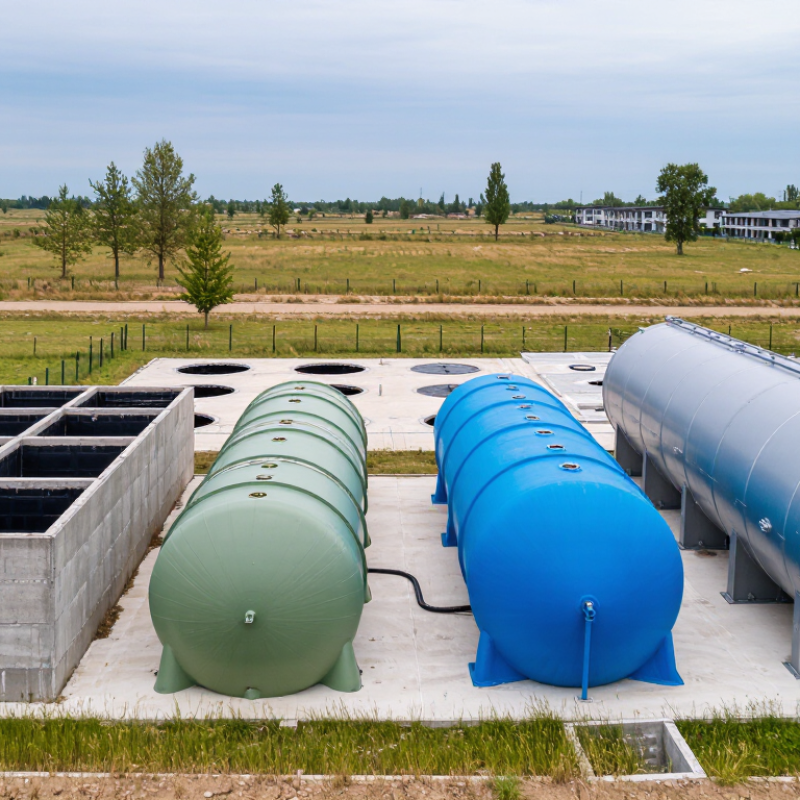
Tank materials vary. Concrete is heavy and often durable, though cracks and installation conditions matter. Polyethylene is lighter and resistant to corrosion, but needs careful anchoring and backfill. Fiberglass offers low weight and corrosion resistance, yet handling damage is possible. A tidy product chart makes the choice look simple. It isn’t always. Soil, groundwater, daily flow, access for service, and local design requirements should guide selection.
Concrete tanks offer substantial weight and can suit sites with stable, well-prepared ground. Their mass may help resist movement, but installation needs lifting equipment, and wastewater gases can contribute to corrosion over time. Polyethylene tanks are lighter and resist many forms of corrosion. That makes transport easier, though groundwater pressure and poor backfilling can cause movement or distortion. Fiberglass also resists corrosion and weighs less than concrete, but its shell still depends on correct bedding and careful installation. No material wins every site.
Design matters as much as material. A single-chamber tank has a simpler layout, while divided chambers can help retain solids and support settling before wastewater exits. Access openings should align with inspection and pumping needs; a buried lid hidden under paving can become an expensive nuisance. Above-ground tanks simplify access but need protection from weather, impact, and temperature changes.
Check local soil conditions, groundwater levels, expected flow, and service access before choosing. A tank that performs well on a dry, firm site may need extra anchoring in saturated ground. The details are easy to miss. Ask the installer how the tank will be bedded, connected, and inspected—not only what it is made from. I would be cautious about choosing by purchase price alone; long-term access and maintenance can change the real cost.
| Tank type and material | Main advantages | Main limitations | Common applications | Key design and installation considerations | Overall fit |
|---|---|---|---|---|---|
| Precast or cast-in-place concrete | High structural mass and strength; suitable for buried installations and sites with traffic loading when designed for those loads. | Heavy to transport and install; cracks or poorly sealed joints can allow leakage. Concrete can be affected by aggressive wastewater environments and may need protective measures. | Septic systems, sewage storage, pump-station wet wells, and larger buried tanks. | Check soil and groundwater conditions, external loading, joint sealing, corrosion protection, and access for inspection. Installation commonly requires lifting equipment or substantial site work. | A strong choice for permanent buried installations where structural capacity and a suitable foundation are priorities. |
| Rotomolded polyethylene (PE) | Lightweight, corrosion-resistant, and generally easy to transport. Seamless molded designs can reduce the number of tank-body joints. | Can deform or become damaged if improperly bedded, backfilled, or subjected to loads beyond its rating. Its low weight increases flotation risk in high groundwater. | Residential septic tanks, wastewater holding tanks, and smaller buried or above-ground applications where the model is approved for the installation. | Follow the manufacturer’s burial-depth and backfill requirements. Assess groundwater and buoyancy; anchoring or other restraint may be required. Do not assume every model is traffic-rated. | A practical option for smaller systems when low weight and corrosion resistance are useful and installation requirements can be met. |
| Fiberglass-reinforced plastic (FRP) | Corrosion-resistant and lighter than concrete; available in a range of shapes and sizes. Can be suitable for wastewater environments when materials are properly specified. | May be vulnerable to damage from poor handling, concentrated loads, or unsuitable backfill. Like other lightweight tanks, it can float in high groundwater if not properly restrained. | Septic tanks, wastewater storage, and certain treatment or pump-station applications. | Verify the tank’s structural rating, resin compatibility, burial instructions, groundwater provisions, and required bedding and backfill. Protect the tank during delivery and installation. | A good candidate where corrosion resistance and lower installation weight matter, provided structural and flotation requirements are addressed. |
| Coated or lined steel | Can provide a strong structure and may be fabricated in large capacities or specialized configurations. | Steel can corrode, particularly in wet or chemically aggressive sewage environments. Coatings and linings can be damaged and require inspection and maintenance. | Selected above-ground storage, industrial wastewater, and engineered applications with appropriate corrosion protection. | Specify corrosion protection for the actual wastewater and exposure conditions. Plan for coating inspection, repairs, access, and any required secondary containment. | Most appropriate when capacity, fabrication, or site requirements favor steel and a suitable corrosion-control plan is in place. |
| Single-compartment tank design | Simpler internal layout and fewer internal partitions. | Provides less separation of solids and liquid than a properly designed multi-compartment tank; suitability depends on the intended process and local requirements. | Holding tanks and applications where the approved system design calls for a single chamber. | Confirm the intended function, required capacity, access openings, inlet and outlet arrangement, and applicable local approvals. | Best suited to applications specifically designed and approved for a single chamber. |
| Two-compartment septic tank design | Separates wastewater flow into chambers, supporting settling and retention of solids within a septic system. | Does not by itself provide complete wastewater treatment or eliminate the need for a suitable downstream soil treatment or other approved process. | On-site septic systems where permitted by local regulations and site conditions. | Size and configure according to wastewater flow, local code, soil and site assessment, and the downstream treatment design. Provide access for inspection and pumping. | A common septic-system configuration where permitted; performance depends on the complete system, not the tank alone. |
| Pump-station wet well | Designed to collect wastewater and provide volume for pump operation; can be built from concrete, PE, FRP, or other approved materials. | Requires pumps, controls, power, alarms, and ongoing inspection. Odor, corrosion, and confined-space hazards need to be considered. | Low-lying sites and sewer systems where wastewater must be pumped to a higher elevation or onward to treatment. | Design for inflow, pump cycling, emergency storage, access, ventilation, electrical safety, lifting equipment, and applicable confined-space procedures. | The right design when wastewater must be actively pumped; material choice should follow site loads and wastewater conditions. |
Selection note: There is no single best tank for every 2026 project. Choose a locally approved design based on capacity, wastewater characteristics, soil and groundwater, loading, installation access, maintenance needs, and applicable codes. Confirm structural ratings and installation requirements for the specific tank model.
The best sewage tank depends on where it will sit and what enters it each day. A small cabin used on weekends may suit a sealed holding tank, provided a pump-out vehicle can reach it and storage covers busy periods. Simple, but not maintenance-free. For a home with steady daily flow, a septic tank may work where soil can absorb treated effluent and groundwater is not too close to the disposal area. A site with clay soil, a high water table, or little room may need a compact treatment unit instead. Check the actual ground conditions, not just a neighbor’s setup.
Wastewater load matters as much as site size. Count regular users, then account for guests, laundry, kitchen use, and short peak periods. A restaurant, workshop, or multi-unit property may send stronger or more variable wastewater than a household. That can call for extra treatment stages or a larger system, not merely a bigger tank. Ask a qualified wastewater professional to review flow estimates, soil tests, access for servicing, and power needs. One detail is easy to miss: future occupancy may change. Still, oversizing without a reason can add cost and complicate maintenance, so estimates should be checked against real use.
What Is the Best Sewage Water Tank Type for 2026?
The best sewage tank depends on site conditions, expected use, and maintenance access—not just its material. Start with daily wastewater volume and peak occupancy. A home with frequent guests may need more capacity than its usual household size suggests. Also check soil stability, groundwater level, installation depth, and vehicle loads above the tank. These details affect buoyancy, structural support, and safe placement.
Concrete tanks are heavy and sturdy, but they need suitable access for delivery and careful inspection for cracks. Polyethylene tanks are lighter and easier to handle, though they must be installed according to site and manufacturer requirements. Fiberglass can resist corrosion, but backfill and installation quality still matter. I would not choose by price alone; that shortcut can look sensible until repairs become difficult. Have a qualified wastewater professional assess local conditions and confirm the tank suits the system.
Tips: Measure access routes before delivery. Ask how the tank will be inspected and emptied. Keep service points reachable, even after landscaping. Small details matter. A site review may change the choice, and that is worth reconsidering before purchase.